5 Things You Can Do This Week to Boost Your Child's Maths Confidence
Simple, practical strategies to help your child feel more confident in Maths — without extra pressure, endless worksheets or the need to be a Maths expert yourself.
A little reassurance before we begin...
If your child is finding Maths difficult at the moment, you might be wondering what more you could be doing to help.
More practice? Extra worksheets? Going over the same methods again?
But sometimes, more isn't necessarily what a child needs.
Often, the biggest difference comes from understanding why something feels difficult, helping them experience a few small successes, and gradually rebuilding their confidence.
And the good news is that you don't need to be brilliant at Maths yourself to make a difference.
Over the next five sections, I'll share some simple, practical things you can try at home. They're based on the approaches I use as a primary teacher and Maths tutor, and they're designed to fit into everyday family life.
You don't need hours of spare time. Just a few minutes, a little patience and a willingness to try something different.
Let's start by looking at what might really be holding your child back.
Chapter 1. Find out what's actually holding your child back
Start by understanding the difficulty, rather than simply giving more practice.
The difficulty you can see isn't always where the problem started.
When your child gets a Maths question wrong, it's tempting to go over the method again or give them more questions to practise. Sometimes that helps. But a mistake can also reveal a gap in an earlier skill — or a child who has lost confidence.
Before giving them more to practise, try to find out what's making the task difficult.
You don't need to diagnose every gap yourself. Start by noticing where your child becomes unsure. That small clue can help you decide what to do next.
A simple place to start
When your child gets stuck, give them time to explain their thinking before stepping in. A couple of gentle questions can help you spot where they feel unsure — without making the moment feel like a test.
“Talk me through what you were thinking"
Give your child time to explain their approach. Listen before correcting them, even if you can see a mistake.
Look for: what they understand and where their thinking goes off track.
“Where did you start to feel unsure?”
Help your child identify the part that feels difficult. They may understand the first steps but get stuck further on.
Look for: the first point of difficulty, not just the final answer.
“What did you do first?”
Ask your child to show you how they began. Sometimes, knowing where to start is harder than doing the calculation.
Look for: whether they can choose a sensible first step independently.
“Can you show me another way?”
Try a drawing, objects or a simpler example. A different approach can sometimes make an idea clearer.
Look for: whether your child understands the idea or is relying on a memorised method.
A closer look: when fractions feel difficult
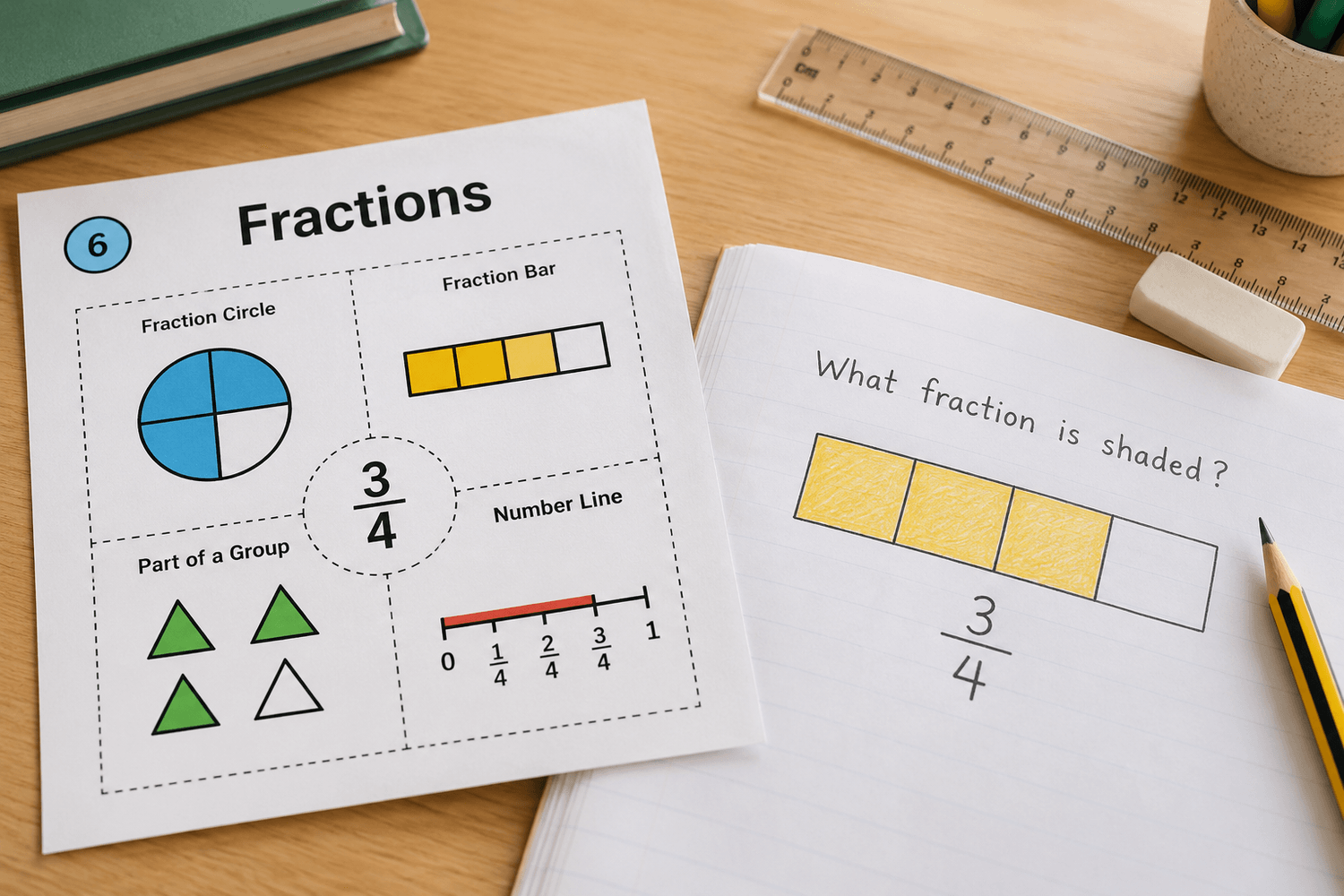
Sometimes, the best next step is to go back one step.
A child who struggles with fractions may need more confidence with an earlier skill, such as recognising equal parts or comparing fractions visually. Before practising more questions, try to find out what they already understand.
If your child isn't sure why 3/4 is greater than 1/2 , ask:
Do the pictures show equal-sized wholes?
How many parts are shaded in each picture?
What do you notice when you compare them?
Try this together
Draw two rectangles of the same size.
Divide one into two equal parts and shade one part.
Divide the other into four equal parts and shade three parts.
Ask: “How do you know which fraction is larger?”
Reassure your child that it's fine if they're unsure. Listen to their explanation and explore the pictures together.
The key takeaway: If your child is stuck, look for the earlier skill they may need to strengthen before moving on to something more advanced.
Next, we'll look at how small successes can help your child feel more confident when tackling Maths.
Chapter 2. Build confidence before asking for more
Small successes help children believe they can succeed.
What their answers might be telling you
One wrong answer doesn't tell you everything. Look for patterns instead.
Does your child make the same kind of mistake repeatedly? Can they explain their thinking, even when the answer is wrong? Or do they lose confidence before they've really begun?
These clues can help you decide whether to revisit an earlier skill, explain an idea in a different way, or simply give your child more time and reassurance.
They know the method but make repeated calculation mistakes
They may need more confidence with times tables, number facts or place value.
Look for: the same mistakes appearing in calculations they otherwise understand.
They can follow an example but struggle to start alone
They may know the steps without fully understanding why the method works.
Look for: difficulty choosing a first step or explaining their reasoning.
They can calculate but struggle with word problems
Your child may be able to do the calculation but struggle to work out what the question is asking.
Look for: difficulty deciding which operation to use, even when they are able to complete the calculation itself.
They say “I can't do it” before they've started
Worry about getting the answer wrong can stop a child from showing what they know. They may give up quickly or avoid questions that look unfamiliar, even when they could make a start.
Look for: needing reassurance at every step, giving up quickly or avoiding unfamiliar questions.
The key takeaway: Look for patterns rather than focusing on individual mistakes. Understanding where your child becomes unsure can help you choose the right kind of support.
Small successes can make a big difference.
When a child has struggled with Maths for a while, even a straightforward question can feel daunting. They may worry about getting it wrong before they've really begun.
Instead of increasing the amount of work, try making the first step feel manageable. A question your child can tackle with a little thought or support can help them experience success and become more willing to try the next one.
Try this: make the first step easier
Start with a question they can attempt. It doesn't have to be completely new or challenging.
Notice the effort. Recognise when they explain their thinking, try a different approach or keep going after a mistake.
Build gradually. Once they feel more comfortable, introduce a slightly trickier question.

Something to say: “Let's work out the first step together. You don't have to know the whole answer straight away.”
The key takeaway
Confidence doesn't mean getting every question right. It means gradually becoming more willing to have a go, learn from mistakes and try again.
Next, we'll look at ways to make Maths feel less overwhelming.
3. Make Maths feel less overwhelming
A big question often becomes easier when you break it into smaller steps.
When a page of Maths looks difficult, a child may not know where to begin. They might look at the whole question, decide they can't do it and give up before they've really tried.
Rather than explaining everything at once, help your child focus on one manageable step at a time.
Try this: break it down
Imagine your child is faced with this question:
Calculate 24 × 6.
Instead of immediately showing them a written method, talk through the calculation in smaller steps:
Step 1: Break 24 into 20 and 4.
Step 2: Calculate 20 × 6 = 120.
Step 3: Calculate 4 × 6 = 24.
Step 4: Add the two answers: 120 + 24 = 144.
The question hasn't changed, but the thinking is easier to organise. Your child can concentrate on one part before bringing everything together.
Three prompts to try
“What do you already know that might help?”
“Can we break this into two smaller parts?”
“What's the first step you could try?”
You don't need to use this method for every question. The aim is to help your child find a way into a problem when it initially feels overwhelming.
The key takeaway
When Maths feels too difficult, resist the urge to explain everything at once. Help your child find one sensible starting point, then build from there.
Next, we'll look at how to build fluency without endless worksheets.
Lorem ipsum dolor sit amet, consectetur adipisicing elit. Autem dolore, alias, numquam enim ab voluptate id quam harum ducimus cupiditate similique quisquam et deserunt, recusandae.
Subscribe here for free
